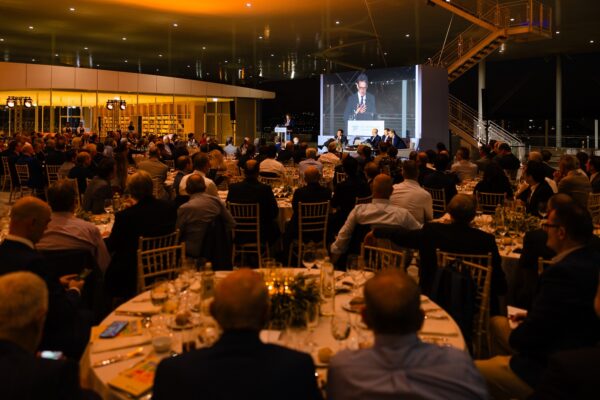


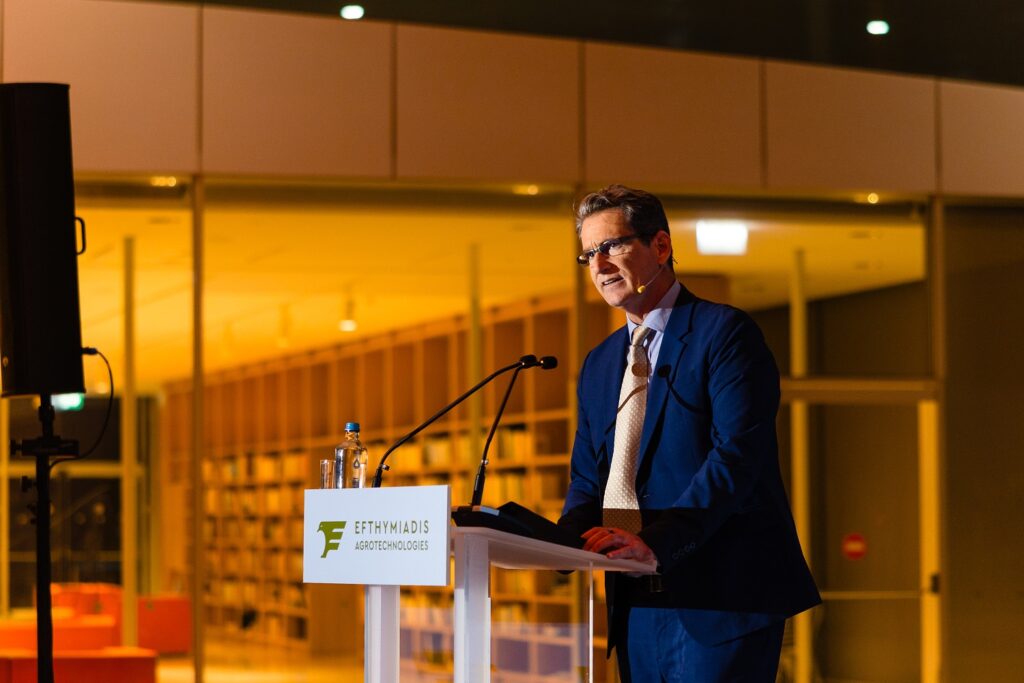
Athens, September 10, 2025 — Honoring a journey that began in 1935 with refugee Efthymis Efthymiadis and a small seed trading business in Thessaloniki, Efthymiadis Agrotechnologies celebrated its 90th anniversary with a high-profile event in Athens.
The three family representatives highlighted different aspects of the Group’s history and strategic vision, outlining its past, present, and future — a journey deeply rooted in Greece, with a clear outward focus and a steadfast commitment to innovation. Today, the Group operates in 12 countries, maintains 6 production facilities in Greece, and employs more than 500 people.
The event featured two leading international executives from global agri-food and health companies: Bill Anderson, Chairman of the Board of Bayer AG, and Gaël Hili, President and CEO of Adama Ltd. A substantive discussion followed on the present and future of agriculture and health, attended by Greece’s Deputy Prime Minister Kostis Hatzidakis and numerous representatives from the political, academic, and business sectors from Greece and abroad.
“The roots are deep.”
Nikos Efthymiadis reflected on the journey from the small seed shop founded by his father in 1935 to today’s internationally active Group. He recalled the challenges overcome over the decades — wars, debt crises, droughts, and floods — yet the company endured:
“Resilience means being ready to adapt.”
He noted that the Group has played a decisive role in shaping modern Greek agriculture, introducing new technologies, promoting scientific progress, and cultivating generations of knowledge.
“Legacy is not kept in a drawer — you live it, you question it, you renew it,” he said, adding that the third generation has made the company more ambitious and international. “The roots are deep. The branches reach far. And I firmly believe the harvests to come will be greater than ever,” he concluded.
Thymis Efthymiadis focused on the importance of data and field research in modern agriculture. He described the Group’s daily presence in fields from Crete to Evros and across the Balkans, aiming to develop crops tailored to local needs. He referred to collaborations with international companies and cotton varieties now expanding beyond Greece.
He emphasized the continuity of three generations of work:
“What my grandfather began with a seed shop, and my father grew into a leading Greek group, we are now expanding with modern genetics, algorithms, AI, and new partnerships.”
“Think globally but act locally. Be tough on problems but gentle with people. Grow with integrity. Innovate with purpose. Lead with humility,” he added.
Vassos Efthymiadis presented the Group’s international expansion, now active in 12 countries with analytical laboratories in five. He emphasized that the goal was never simply to become bigger, but better — for farmers, global partners, and the environment. Looking ahead, he referred to new targeted acquisitions, the development of contract farming, and practices such as carbon farming, noting that “in today’s agriculture, growth knows no borders.”
He added that the mission of the next decade is to prove that Greek know-how can meaningfully contribute to tackling the challenges of the future.
Adaptation and Innovation
Mr. Anderson praised Greece and spoke warmly of its hospitality and people — and especially of the Efthymiadis family. He highlighted the importance of modern agriculture, using the central motto:
“Health for all, hunger for none.”
He announced that a new, revolutionary “short” corn variety will soon be launched in Greece, expected to significantly boost productivity.
“Agriculture is a dynamic process — it requires adaptation and innovation,” he said, stressing the need for a regulatory environment that supports innovation. He noted that the EU is lagging in terms of global competitiveness.
Although “strongly pro-European,” he admitted that the EU “in its current form will not succeed.”
“The world is moving too fast, and the existing system hinders innovation and progress,” he warned, adding, “Few are willing to admit that the system has come undone — I respect Europe’s leadership, but it’s time for courageous politicians to make decisions.”
He also noted that “bureaucracy remains strong both in large companies and governments,” calling for its reduction — citing Bayer’s internal flexibility as an example of how decentralizing decisions promotes agility.
“Businesses must keep their focus on innovation,” he stressed, wishing the Efthymiadis family continued success in their mission.
Mr. Hili recalled that when he first came to Greece 20 years ago, he met clients of the company he then worked for — among them, Vassos Efthymiadis — and praised Efthymiadis Agrotechnologies for its professionalism.
He went on to discuss the challenges facing modern agriculture, from climate change to rapid population growth, expressing optimism that the agricultural industry can overcome them.
He placed special emphasis on emissions, noting:
“If no action is taken, global agricultural activities are projected to reach 15 gigatons of CO₂ by 2050. The target, however, is to reduce them to 4 gigatons so that agricultural production remains sustainable and meets the requirements of the green transition.”
He summarized the future strategy in three pillars: increased productivity, economic viability, and environmental responsibility.
“In practice, this means agriculture must produce more with fewer resources, remain profitable for farmers, and at the same time reduce its environmental footprint,” he said, also referring to the importance of new seed varieties.
He emphasized that
“AI is changing the game in agriculture,”
and spoke about the potential of digital agriculture in emerging economies. According to data, the use of technologies such as sensors, drones, and artificial intelligence could boost the agricultural GDP of low- and middle-income countries by $450 billion annually.
He underlined the power of collaboration:
“The agriculture of the future cannot rely on isolated efforts but on networks of cooperation among farmers, scientists, companies, and institutions,”
and referred to regenerative agriculture, a holistic approach led by farmers themselves.
He concluded by saying:
“We must embrace innovation to build a resilient food system for future generations. Part of innovation is being able to fail — and then try again.”
The event’s speeches and discussion panel were moderated by Alexis Papachelas, Director of Kathimerini newspaper.


Alexis Papachelas, Director of Kathimerini newspaper – Bill Anderson, Chairman of the Board, Bayer AG – Gaël Hili, President and CEO, Adama Ltd – Thymis Efthymiadis, Vice President, Efthymiadis Agrotechnologies Group – Vassos Efthymiadis, Vice President, Efthymiadis Agrotechnologies Group